Traffic and Transport
|
Program study
|
TRAFFIC AND TRANSPORT
|
|
NQF Level (with abbreviations such as BA, MA, PhD, doctoral program, university course, professional certificate or diploma)
|
BSc (Bachelor of Science))
|
|
Academic degree and full/abbreviated title of the diploma
|
Bachelor of Engineering in Traffic and Transportation
Program:
TRAFFIC AND TRANSPORT
|
|
Field of Study according to Erasmus Subject Area Codes (ESAC)
|
02.6 Transport and Traffic Studies
06.1 Mechanical Engineering
|
|
Minimum Duration of Studies
|
3 years
|
|
Form of Study (full-time, part-time, distance learning, etc.)
|
Full-time
|
|
Number of ECTS Credits (total and per year)
|
180 ECTS
|
|
Program Coordinators:
|
1. Prof. ass. dr. Ramadan Duraku
2. Prof. ass. dr. Arlinda Rrecaj
3. Prof. ass. dr. Gëzim Hoxha
|
|
Tuition Fees
|
Based on the decision of the Government of the Republic of Kosovo, studies are free of charge.
|
| |
|
|
To meet the objectives of the Traffic and Transport program, three modern laboratories have recently been established:
- Central Laboratory, equipped with advanced technology and equipment for scientific-research and professional purposes, as well as other materials necessary for the teaching process;
- Vehicle Technical Inspection Laboratory, which serves for the development of professional, scientific-research, and service activities within the traffic and transport program;
- IT and SMART Technologies Laboratory, dedicated to implementing scientific-research projects with students in the fields of Intelligent Transport Systems (ITS) applications in traffic, automatic control in traffic and transport, and road telematics.
This program strongly aligns with the short-term and long-term objectives of the Faculty of Mechanical Engineering (FIM), clearly outlined in its strategic and developmental plans.
Since one of the main goals of FIM is to offer high-quality study programs in line with contemporary standards and practices, the objectives of this program are consistent with that mission.
- The Bachelor program content enables students to gain an in-depth scientific and research-based foundation of engineering knowledge, as well as sufficient skills and experience for both individual and team work when solving practical problems in areas such as traffic analysis and planning, mobility and urban movement, road evaluation and maintenance, basic elements of road safety, transport technology (with an emphasis on passenger and freight transport), maintenance and operation of road vehicles, freight forwarding and international transport, and intelligent transport systems (ITS). It also provides a suitable basis for further academic studies.
- As part of the Traffic and transport program, graduates are educated in the field of transport and traffic engineering, aiming at economic development and improving the standard of living.
Program Objectives
The objectives of the Bachelor studies in Traffic and Transport to provide knowledge and skills for students to:
- Educate students with a broad range of knowledge, enabling them to innovatively connect theoretical knowledge with practical application in solving traffic and transport problems;
- Fulfill the expected knowledge outcomes in the field of planning and management of transport systems, in harmony with sustainable development and market demands;
- Prepare students for further studies at the second (Master’s) level in Traffic and transport engineering or related fields;
- Achieve comparable and competitive knowledge by following local and international development trends;
- Enable students to conduct research work within expert teams in traffic and transport, environmental protection, road safety, intelligent systems, social sciences, etc.
ADMINISTRATION OF THE TRAFFIC AND TRANSPORT PROGRAM-BSC
The administration of the Traffic and Transport program is carried out in accordance with the Statute of the University of Prishtina and the internal regulations that govern the organization of academic processes at the faculty and University of Prishtina level. The organizational structure ensures effective academic management, pedagogical coordination, transparency, and compliance with quality assurance standards.
Institutional structure of administration
The program is administered by the academic unit - the faculty and the department, which function as constituent units of the University of Prishtina.
The structure includes:
- Management - the Dean of the faculty, who supervises academic processes and ensures the implementation of institutional policies and regulations;
- Vice Deans for academic, teaching, and research affairs;
- The Head of the Department, who leads academic activities within the department and ensures the proper conduct of teaching and research processes;
- Coordinator for Academic Development and Quality, who monitors quality, evaluations, reports, and the implementation of institutional standards;
- Quality Office, which ensures documentation of processes, periodic evaluations, and coordination with the central units of UP for quality;
- Head of administration.
- The administrative structures are clearly defined and also described in the self-evaluation report of the accredited program 2023–2028 by AKA.
The administrative structures are clearly defined and also described in the self-evaluation report of the accredited program 2023–2028 by KAA.
Administrative functions of the program
Program administration includes:
- Drafting, reviewing, and updating the curriculum;
- Approval of course programs according to the procedures of the Faculty Study Commission;
- Coordination of schedules, lectures, exercises, and laboratories;
- Planning of academic staff workload for lectures and exercises.
Program monitoring is conducted:
- At faculty level by the Dean, Vice Dean for teaching, and the Quality Coordinator;
- At department level by the Head of the department.
- At institutional level by the central offices of UP for quality and academic development.
Administrative support and infrastructure
The program is supported by:
- The Student Services Office, which manages documentation, registration, exam records, and student communication;
- SEMS (Student Electronic Management System), for course registration, grades, academic records, and official communication;
- Teaching spaces, laboratories, library, technical units, and support staff.
This integrated administrative system ensures preservation, access, and transparency of academic data.
Quality assurance in program administration
Program administration is closely linked to:
- Periodic evaluation of academic and support staff;
- Student questionnaires;
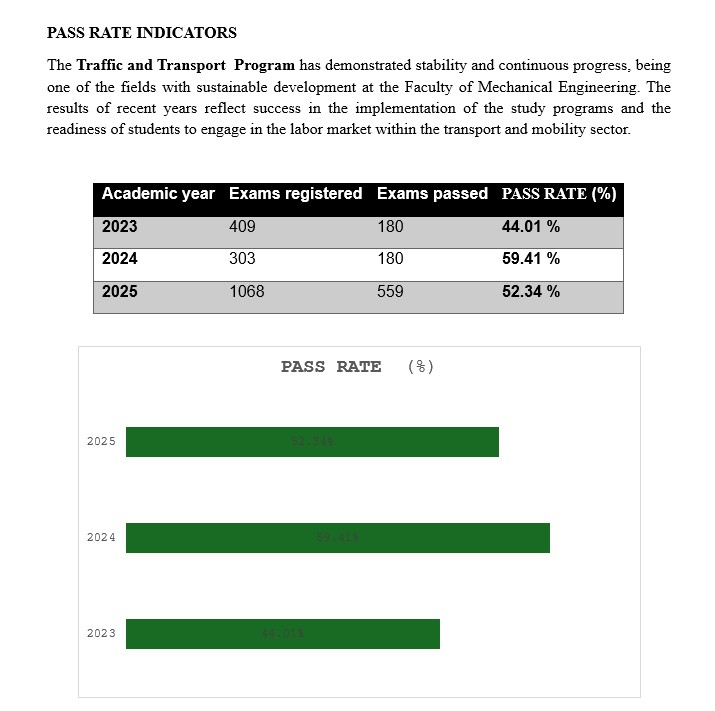
- Analysis of pass rates and study progress;
- Annual academic reports;
- Curriculum review aligned with accreditation standards and labor market needs.
Cooperation with industry and public institutions
Continuous improvement and development of the Traffic and Transport program is supported through close cooperation with industry. At the Faculty of Mechanical Engineering, an advisory board has been established which, besides industry representatives, also includes representation from students and alumni.
- In addition to program review and development, this also helps in:
- Creating and strengthening relationships with institutions of road, air, railway transport and logistics;
- Organizing professional internships and study visits;
- Engaging industry experts in teaching or advisory activities.
- This cooperation ensures the program remains aligned with real labor market needs.
Student representation in program administration
Students participate in the administration of the program through:
- The Student Council of the Faculty;
- Student representatives in the Study commission;
- Student representatives in the faculty council;
- Participation in quality assurance commissions;
This representation ensures that the student voice is part of the decision-making processes.
ASSESSMENT PROCEDURES WITHIN THE PROGRAM
The assessment procedures within the program are aligned with institutional policies and relevant regulations (The General Regulation on the Assessment of Student Performance) of the University of Prishtina, as well as with the standards defined by the Kosovo Accreditation Manual. These procedures ensure a fair, transparent, objective, and continuous evaluation of student performance.
General Principles of Assessment
At the program level, assessment mechanisms are clearly defined for each course through the corresponding syllabus, which is published in the electronic SEMS system at the beginning of each semester, providing students with immediate access to the assessment criteria.
These mechanisms are designed to reflect teaching methods, expected learning outcomes, and student workload.
The institutional standard requires that assessment be conducted fairly and objectively, be consistent over time, and comparable across courses within the program.
Assessment Formats and Components
Assessment methods include a combination of formative and summative evaluations, which typically include:
- Continuous assessment (according to the Regulation on the Assessment of Student Performance)
- Attendance in lectures and exercises (e.g., 5%)
- Interactivity and engagement during class (e.g., 5–15%)
- Continuous testing throughout the semester, usually two mid-term exams (up to 70–90%)
- Independent assignments, presentations, projects, and practical work (variable depending on the course)
- Final exam if the student does not pass the course through continuous assessments.
This combination allows the student to demonstrate competencies through multiple forms of evaluation.
Transparency and Student Information
Students are informed at the beginning of each semester about assessment criteria, teaching methods, testing formats, and the weight of each component. Course syllabi within the program are uploaded to SEMS at the beginning of the academic year, and professors clarify all details during the first teaching sessions.
Additionally, students receive immediate and regular feedback on their performance, in accordance with Standard 5.4.
Recording, Archiving, and Certification of Assessment Results
Results of exams, tests, and other assessment components are recorded and stored in the official SEMS system. This system serves as the official mechanism for certifying and preserving academic results long-term, as required by accreditation standards.
Results are also stored in physical form at the faculty for internal auditing needs, as well as for access by professors, administration, and management.
Objectivity, Validity, and Reliability of Assessment
The program implements mechanisms that ensure assessments are:
- aligned with the intended learning outcomes,
- standardized according to course syllabi,
- comparable across courses,
- consistent with practices of other programs within the institution.
Assessment Criteria
All academic units of the University of Prishtina, in accordance with the Statute, apply the following grading scale to evaluate student achievements:
- 10 and 9 – Excellent
- 8 – Very Good
- 7 – Good
- 6 – Sufficient
- 5 – Insufficient
A student successfully completes a course by achieving at least a grade of 6 (Sufficient).
The precise distribution of points across these components is defined in the syllabus of each course, however, all courses follow the same University-wide grading scale presented above.